
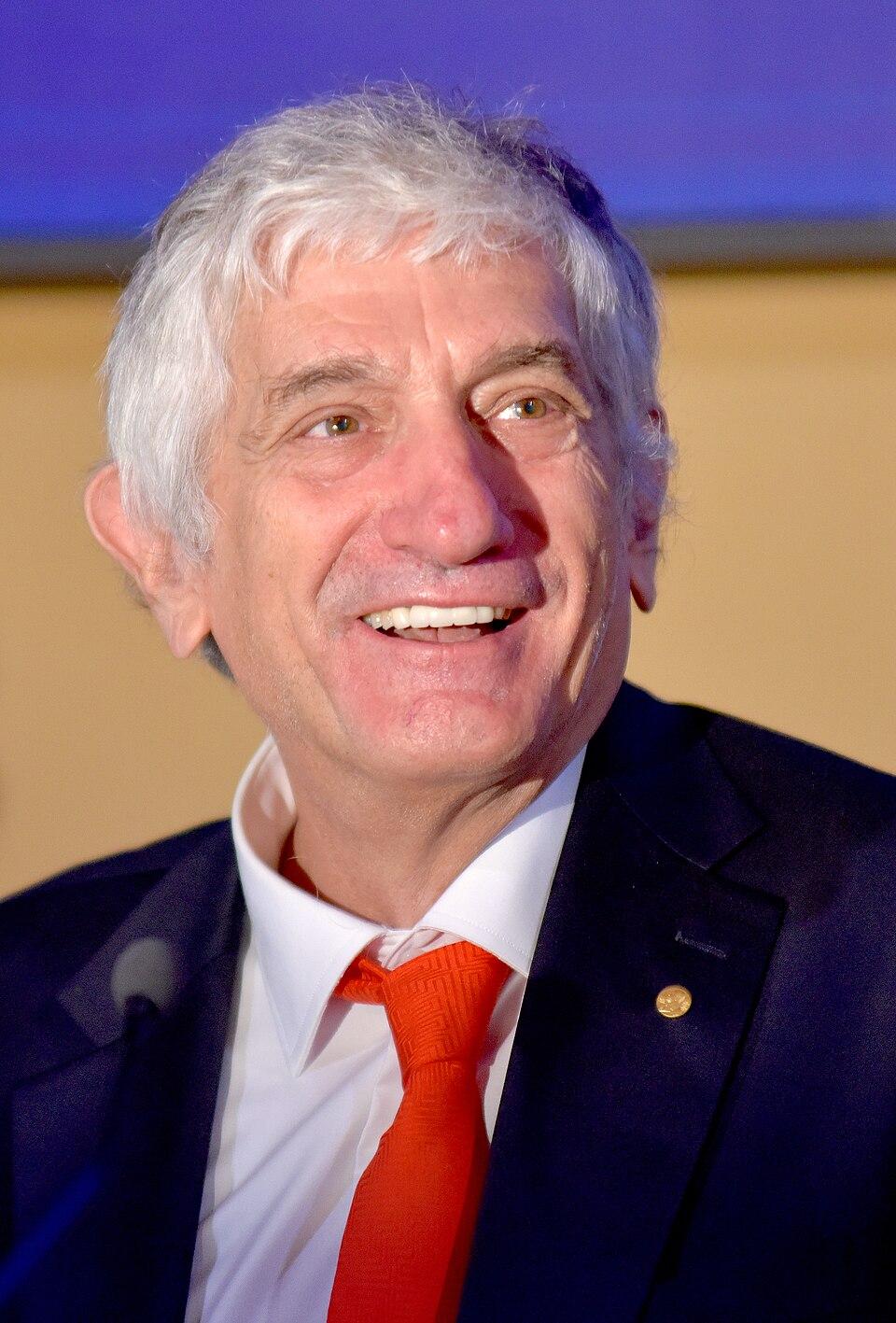


Martinis develops superconducting quantum hardware, contributing to surface-code architecture and the Sycamore random-circuit experiment, and now works on scalable processor engineering as Qolab’s CTO.
QolabarXiv / Physical Review ANatureMartinis connects superconducting device engineering with the demands of quantum computation. His collaborative surface-code paper makes protection requirements concrete through logical operations and resource estimates. The Sycamore experiment later tested programmable superconducting hardware on a specific sampling benchmark. Its historical performance comparison should be read in that setting, rather than as a claim of advantage for all useful applications. His current Qolab role continues the engineering focus on building and scaling quantum processors.
QolabarXiv / Physical Review ANatureThe work behind the recognition
Work, in context- 2012
Making surface-code computation concrete
With Austin Fowler, Matteo Mariantoni and Andrew Cleland, Martinis described how surface-code logical qubits and universal operations can be constructed, estimating fault-tolerance requirements and the resources needed for a large quantum computer.
Coauthor with Austin Fowler, Matteo Mariantoni and Andrew Cleland of the surface-code architecture paper.
Source-supported recordarXiv / Physical Review A - 2019
The Sycamore random-circuit experiment
Martinis coauthored the experiment using 53 programmable superconducting qubits to sample quantum-circuit outputs. The team compared that specific task with classical simulations; the paper’s historical benchmark does not establish universal practical advantage.
Coauthor of the Sycamore experiment; the benchmark and its interpretation concern the full team’s specific sampling task.
Source-supported recordNature
Keep in perspective
Historical Sycamore comparison is qualified; no present-day speedup factor or broad practical advantage is asserted.
Work-base country is omitted rather than inferred from company office locations.
The evidence map
Both views link each contribution to its sources. Choose a contribution on the map or read them all in the list.
Making surface-code computation concrete
Surface codes: Towards practical large-scale quantum computation
Supports: Authorship, logical operations, fault-tolerance and resource treatment.
Published 4 Aug 2012 · Checked 19 Sept 2026Credit & limits: Coauthor with Austin Fowler, Matteo Mariantoni and Andrew Cleland of the surface-code architecture paper.
Read the full contribution| Contribution | Evidence & what it supports | Credit & limits |
|---|---|---|
| Making surface-code computation concrete2012 | Primary paperSurface codes: Towards practical large-scale quantum computation Authorship, logical operations, fault-tolerance and resource treatment. Published 4 Aug 2012 · Checked 19 Sept 2026 | Coauthor with Austin Fowler, Matteo Mariantoni and Andrew Cleland of the surface-code architecture paper. |
| The Sycamore random-circuit experiment2019 | Primary paperQuantum supremacy using a programmable superconducting processor Authorship, 53-qubit sampling task, experimental comparison and scope. Published 23 Oct 2019 · Checked 19 Sept 2026 | Coauthor of the Sycamore experiment; the benchmark and its interpretation concern the full team’s specific sampling task. |
Follow the evidence
3 sourcesPrimary papers, institutional records and attributed announcements. Each source supports the claims linked above.
- QolabInstitutional record
Qolab team
Current CTO and cofounder identification.
Checked 19 Sept 2026 - arXiv / Physical Review APrimary paper
Surface codes: Towards practical large-scale quantum computation
Authorship, logical operations, fault-tolerance and resource treatment.
Published 4 Aug 2012 · Checked 19 Sept 2026 - NaturePrimary paper
Quantum supremacy using a programmable superconducting processor
Authorship, 53-qubit sampling task, experimental comparison and scope.
Published 23 Oct 2019 · Checked 19 Sept 2026