
The hidden work behind a quantum result
A billion-gate circuit still has to fit into ordinary software. A superconducting material can lose one component as it gets colder. A second measurement channel can improve the picture of a qubit. Nine new explanations examine what recent research and announcements establish, with an update to Intel’s Classiq deal and the key limits kept beside each result.
Published · Los Angeles · 10 selected stories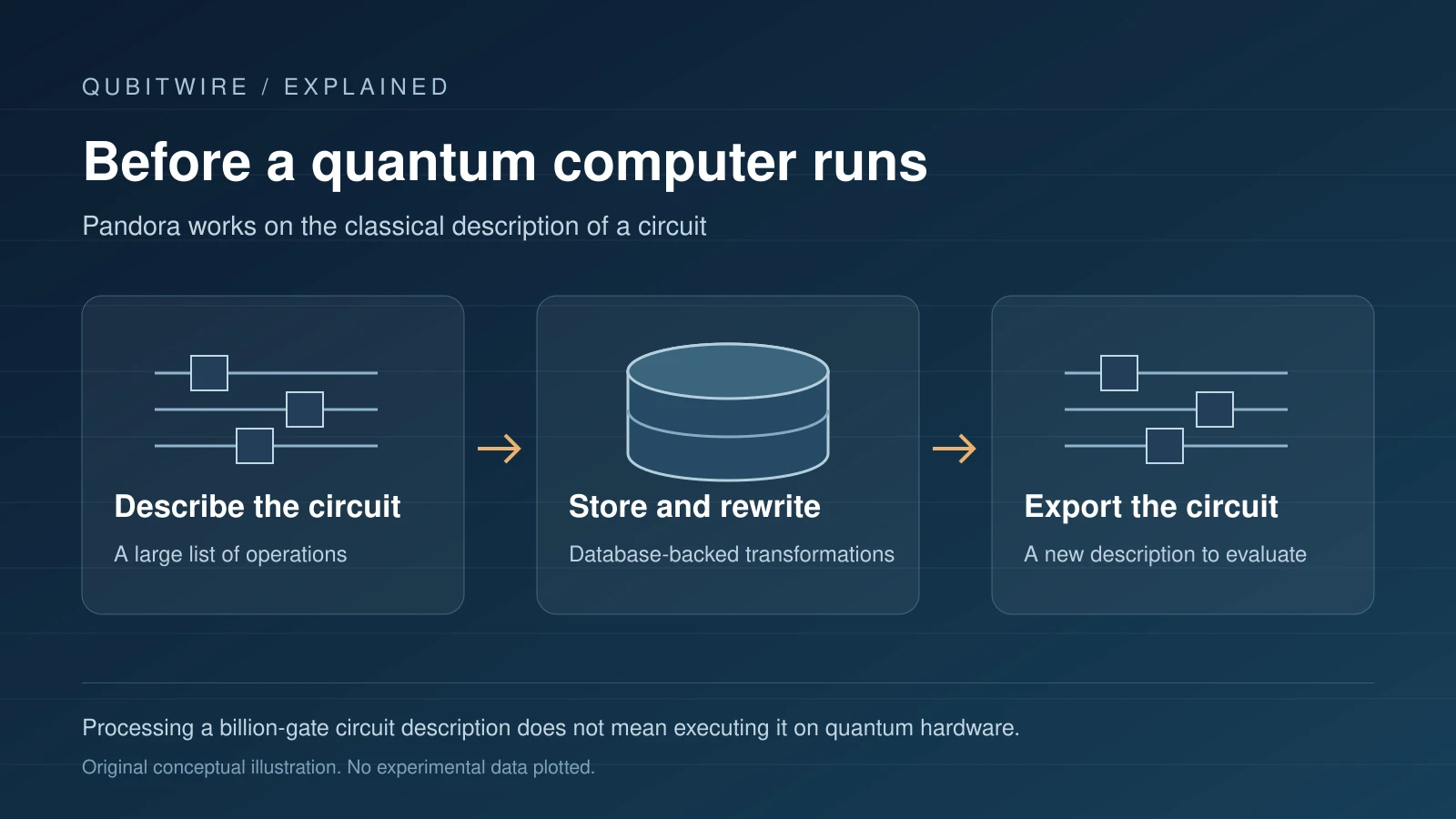
Quantum software has a scale problem before a machine ever runs
Pandora brings database techniques to enormous circuit descriptions. Its new publication is a software milestone with specific benchmark limits.
October 30 journal milestone; full earlier preprint reviewed. These are classical circuit-processing results, not execution on quantum hardware.
Ultra-large-scale compilation and manipulation of quantum circuits with Pandora ↗
Cooling can push one superconducting state out of the way
Ultrasound measurements in UTe₂ support competing superconducting components. One disappears on cooling while the material remains superconducting.
October 30 journal milestone. Thermodynamic evidence supports competing superconducting components, not a protected qubit or proof of topology.
Thermodynamic demonstration of tetracriticality and multicomponent superconductivity in UTe₂ ↗
Intel’s filing adds the terms to its Classiq deal
The existing October 27 article now includes approximately $1.9 billion in consideration and up to $350 million tied to performance milestones.
Canonical update, November 2. The transaction remains proposed; the milestone amount is contingent and the price remains subject to customary adjustments.
Intel October 30 quarterly filing, Note 9 ↗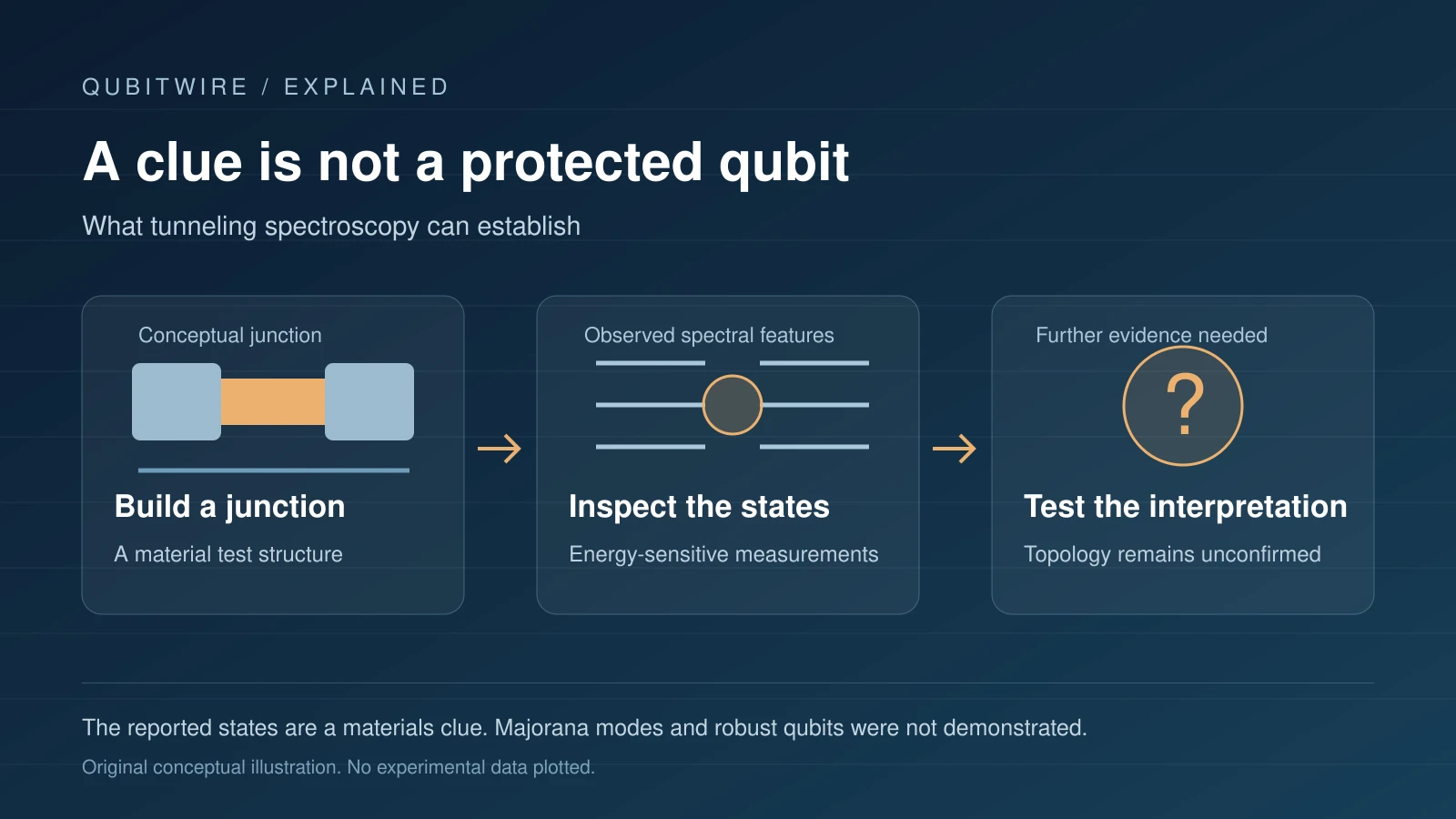
A promising quantum-material clue still has one decisive test ahead
Cologne researchers report states consistent with a route to topological superconductivity. The transition that would strengthen the case remains unconfirmed.
November 2 university announcement of published work. The topological transition remains unconfirmed; a matching preprint first appeared in 2024.
Cologne: Experiment supports a promising route to more robust quantum computing ↗
A second signal could help quantum computers read their qubits
An IBM research paper combines two amplifier outputs to improve a measured readout, with broader high-gain performance still calculated.
October 30 journal milestone. Low-gain experiment and higher-gain calculations are different evidence; no general computing speedup is established.
Enhancing qubit readout fidelity with two-mode squeezing of the coherent measurement signal — EPJ Quantum Technology ↗
A quantum location test confronts stronger attackers
A multi-basis protocol simplifies preparation while making the limits of its expanded security model explicit.
October 31 journal milestone for theory first posted in 2025. The security result depends on a bounded attacker model.
Efficient multi-basis quantum position verification secure against generalized adversaries ↗
A small-qubit chemistry claim hides thousands of calculations
PNNL’s Quantum Flow highlight shows why a small subproblem and a small total workload are different promises.
October 30 PNNL highlight of a paper first published online September 23. Small subproblems still require substantial total computation; detailed full methods were unavailable.
Quantum Information Harvesting with a Parallel Quantum Flow Algorithm — PNNL research highlight ↗
Why quantum hindsight depends on what you already know
A unified smoothing framework shows why the correlations in a prior can change a retrospective quantum estimate.
November 1 journal milestone for theory first posted in 2025. The new focus is prior correlations; inference does not change the past.
Unifying quantum smoothing theories with extended retrodiction ↗
What a quantum lung-cancer prediction score can actually tell us
A small augmented dataset, a hardware comparison and an unresolved validation question explain why a headline accuracy is only a starting point.
November 2 announcement about a September 9 study. Augmented samples are not extra patients; independent clinical validation and a preprocessing question remain open.
Inferring lung cancer under limited learning data through gate-based and annealing-based quantum techniques ↗
Canada joins EuroHPC. Machine time still starts with an application.
Canada’s October 30 membership expands computing cooperation with Europe. The quantum pilot offers a concrete route for testing proposals, subject to assessment.
October 30 participation announcement. Pilot access still requires eligibility and assessment. Call details checked November 2 may change.
Canada becomes the 39th participating state of the EuroHPC Joint Undertaking ↗What happened between the headline and the result?
Look for the original data, the processing steps, the comparison and the remaining uncertainty. A small resource count, a high score or a new publication date answers only part of that question.
Compare the recorded evidence →Follow the evidence further.
Move from the research to the physical mechanism, then work through the tradeoff yourself.
A useful way to read this page
Choose a route according to the question you want it to answer.
Reader guideBriefing: read a dated edition and a live preview for different purposesUse a fixed edition for its original selection, the archive for history and the preview for its currently displayed status.
A dated briefing preserves an editorial selection for that edition. Its linked articles can acquire corrections or additional context later, so the edition date and an article’s update date answer different questions. Use the archive to revisit what was selected at a particular time and the live preview to inspect the current selection.
When comparing editions, look for a changed claim or new evidence rather than assuming every repeated organization has produced a new technical result. Record the source date, the reported event date and the reason the item matters together. This makes a useful chronology without treating a new publication date as a new experiment.
The archive, preview and feed routes provide different ways to read the publication. A visible edition or feed is not a promise of email delivery, an individual alert or a fixed future publishing schedule. Check each route’s own description when choosing how to return.
Questions to take with you
Why can a linked article change while the edition stays dated?
The edition preserves its original selection. The article can carry later corrections or context. Reading both dates prevents those two records from being confused.
Does reading or bookmarking an edition join email delivery?
No such action is described here. Email signup and status have their own existing route and choices; this module does not submit or confirm a subscription.
Sources and their boundaries (1)
- Current on-site edition: What changes when the key on your desk goes post-quantum? ↗QubitWire · Published 2026-11-03
4 stories in this dated edition. Older editions remain in the archive; the live preview is a separate, changing selection.
On-site publication does not establish email delivery. The signup is a launch list while scheduled email delivery remains inactive.