Research2 min read
A new theory result uses persistent quantum memory to decode weak coded rotations that comparable classical-memory receivers lose.
Research2 min read
A biphoton frequency-bin experiment reconstructed a 100-dimensional state from 1.9% of a conventional measurement set by exploiting sparsity.
Research2 min read
Standard Clifford+T synthesis gave the wrong transport exponent in a Heisenberg-model test. A measurement-assisted compiler preserved SU(2) exactly and used about five times fewer T gates at matched accuracy.
Research2 min read
Circuit simulations suggest flat roughly 100-qubit modules with sparse boundary connections could cut memory overhead tenfold or more versus surface codes.
Research2 min read
A compressed 420-gate workflow on Forte Enterprise reconstructed how a model magnetic spectrum changes with field, then checked the result against tensor networks and neutron data.
Research2 min read
Tsinghua simulations rank each circuit component by its contribution to logical failure, then show targeted improvements beat the same budget spent at random.
Research2 min read
esQueranto puts photon-number physics and structured light in one differentiable JAX program, so researchers can optimize optical parameters instead of only sweeping them.
Research2 min read
A new preprint models an adaptive attacker that follows changing channel noise. It does not show a breach of deployed QKD equipment.
Research2 min read
A new model predicts electric-field noise from dielectric and metallic losses and comes within a factor of four for one tested trap.
Research2 min read
A new preprint uses neural networks to flag likely decoding failures. Large error reductions apply to retained simulated results, with a cost in discarded attempts.
Research2 min read
ORNL highlights a smaller phase-estimation circuit. The useful question is whether fewer gates also make a complete calculation more practical.
Research3 min read
A blinded study points to nanoscale oxide and etching differences as clues to uneven qubit lifetimes.
Research3 min read
A cavity changes how a quantum dot releases light, improving photon interference while separating the useful signal from the excitation laser.
Research2 min read
A levitated nanosphere’s motion became entangled with light leaving an optical cavity. The intriguing part is the interface, not a finished quantum memory.
Research3 min read
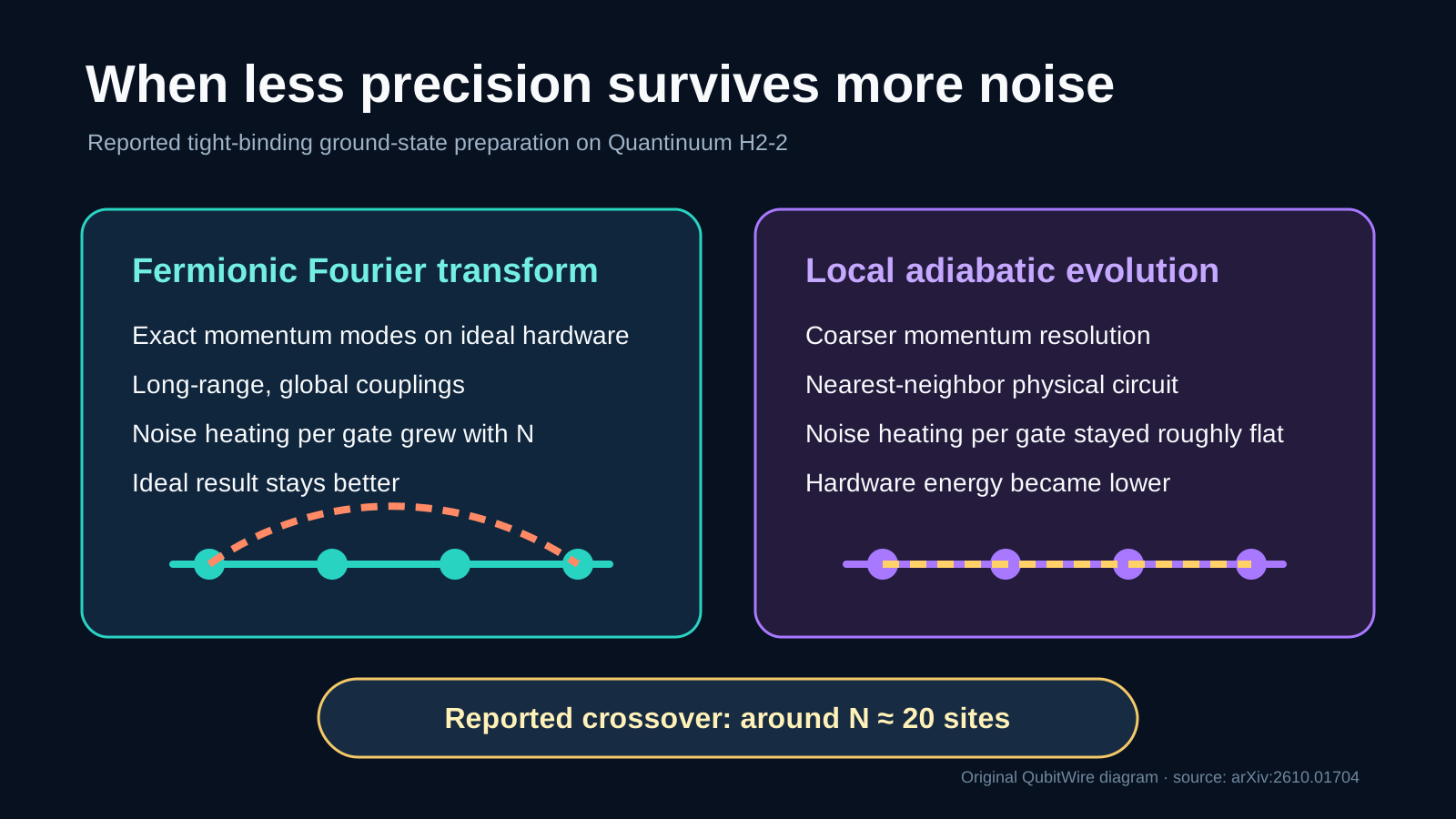
A 48-qubit experiment found that a local adiabatic circuit could beat an exact fermionic Fourier transform once noise entered the picture, exposing a blind spot in gate-count optimization.
Research3 min read
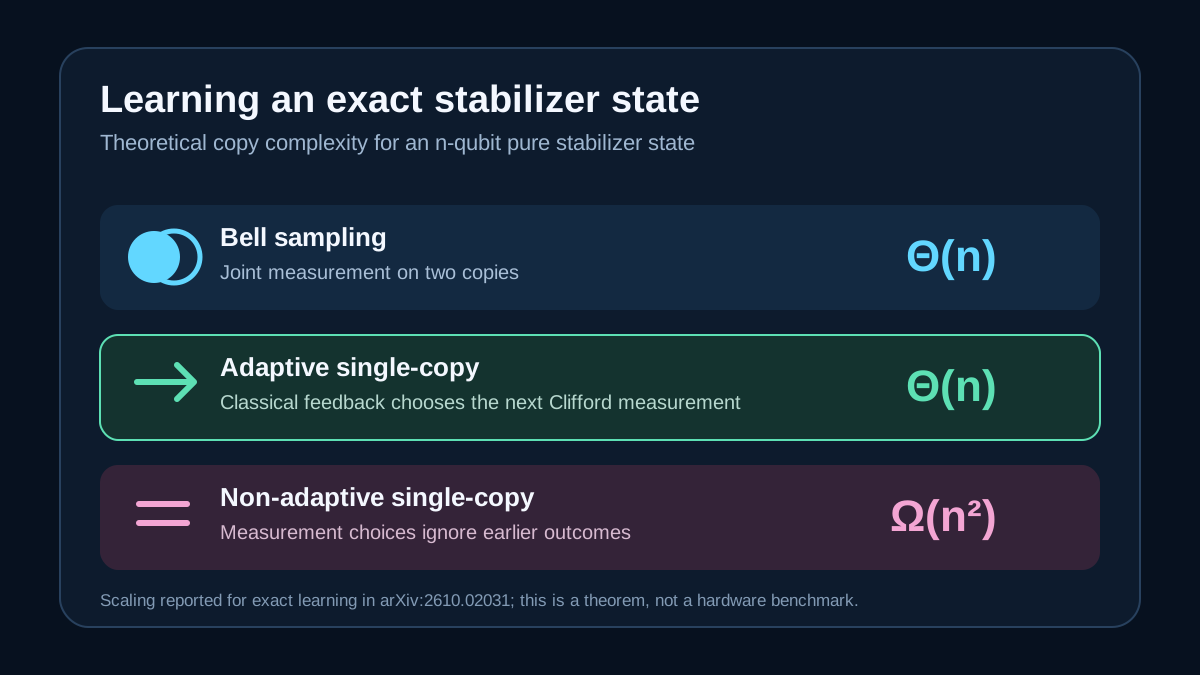
A new proof shows that adaptive single-copy measurements can learn an exact stabilizer state with the same linear copy scaling as joint Bell measurements, without coherent access to two copies at once.
Research3 min read
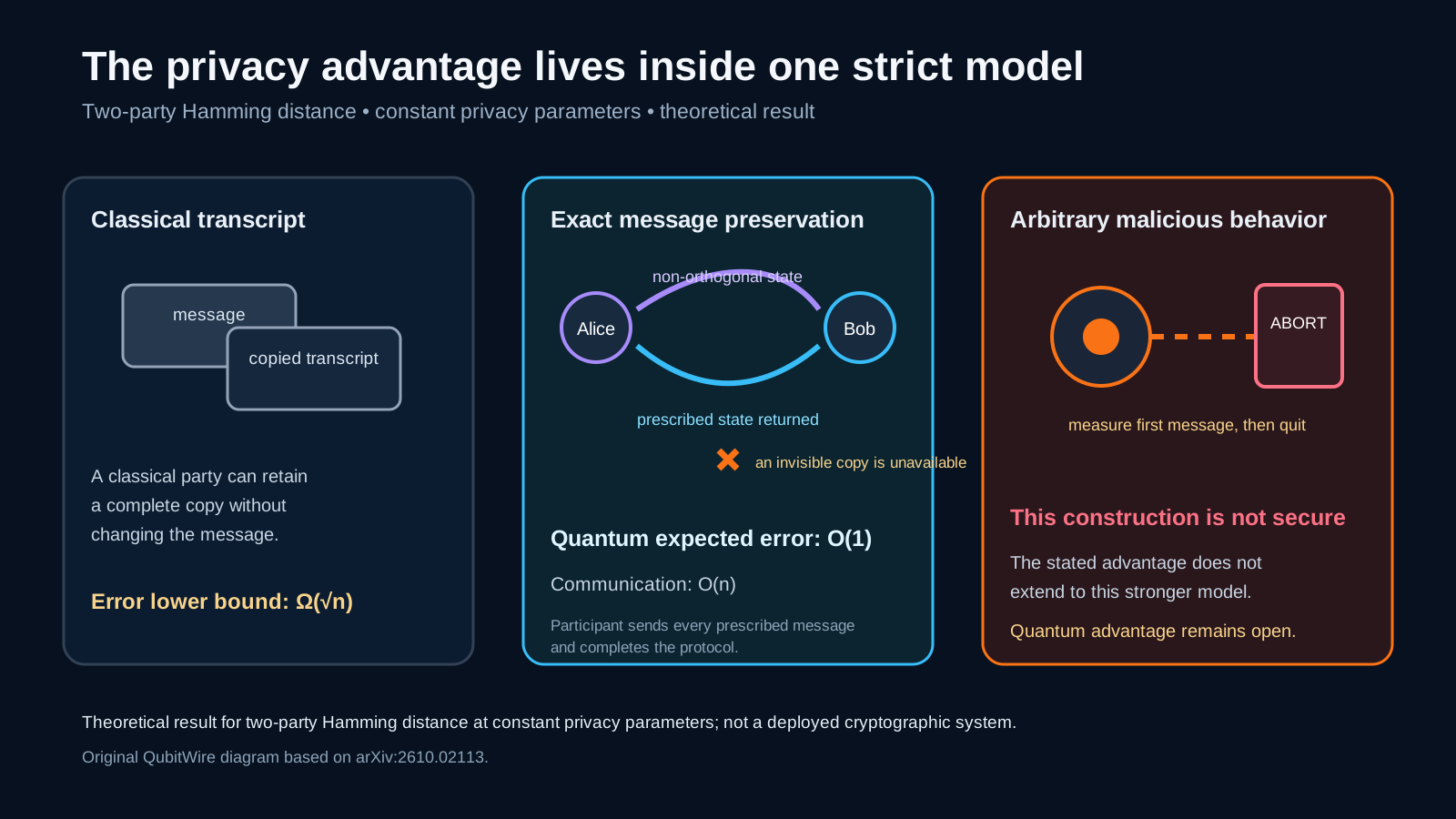
A new theorem gives constant expected error for private two-party distance estimation, but only when each participant returns the prescribed quantum message and completes the protocol.
Research3 min read
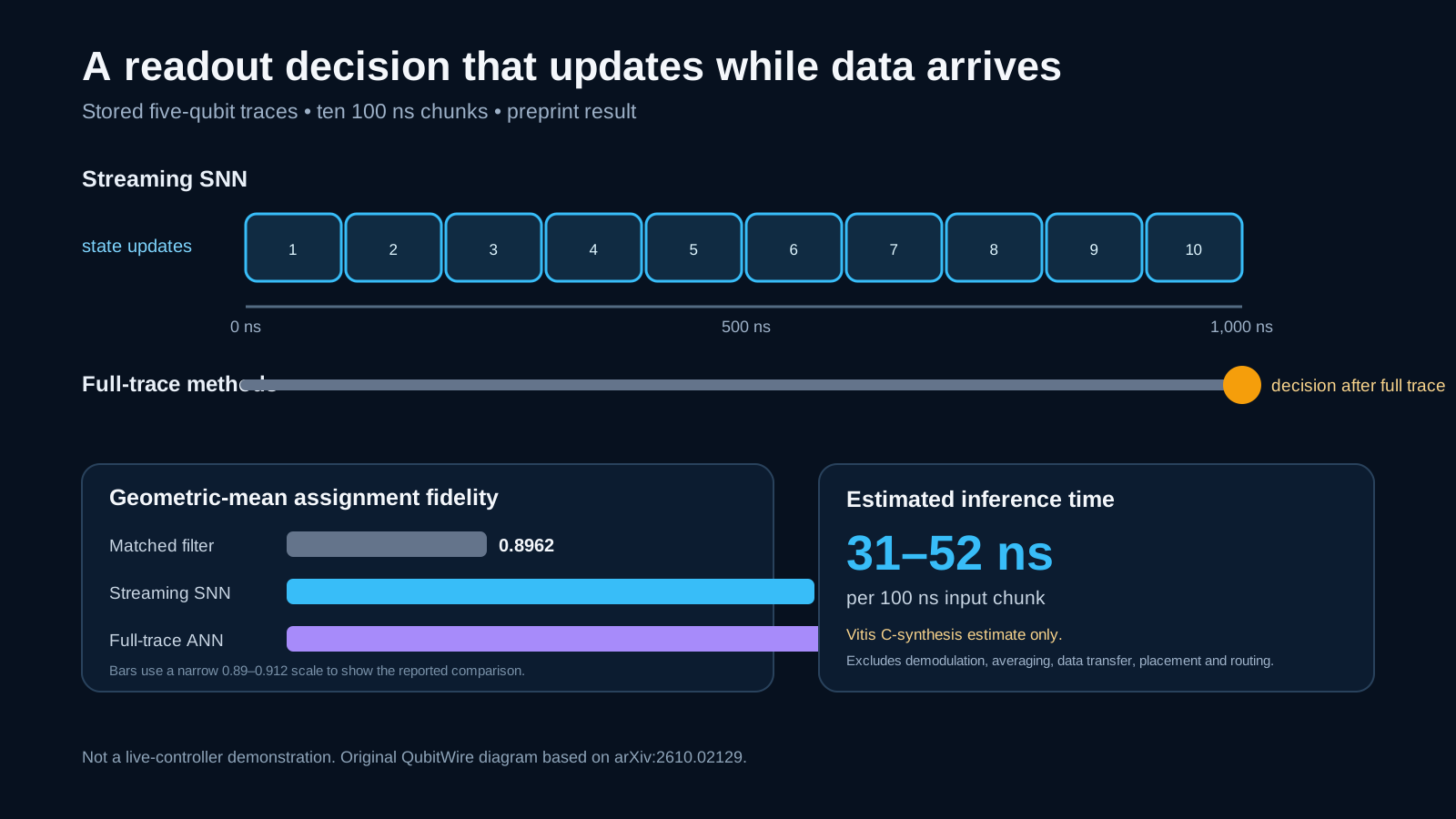
A spiking neural network nearly matched a full-trace classifier on stored five-qubit readout data while producing updated answers as each 100-nanosecond chunk arrived.
Research3 min read
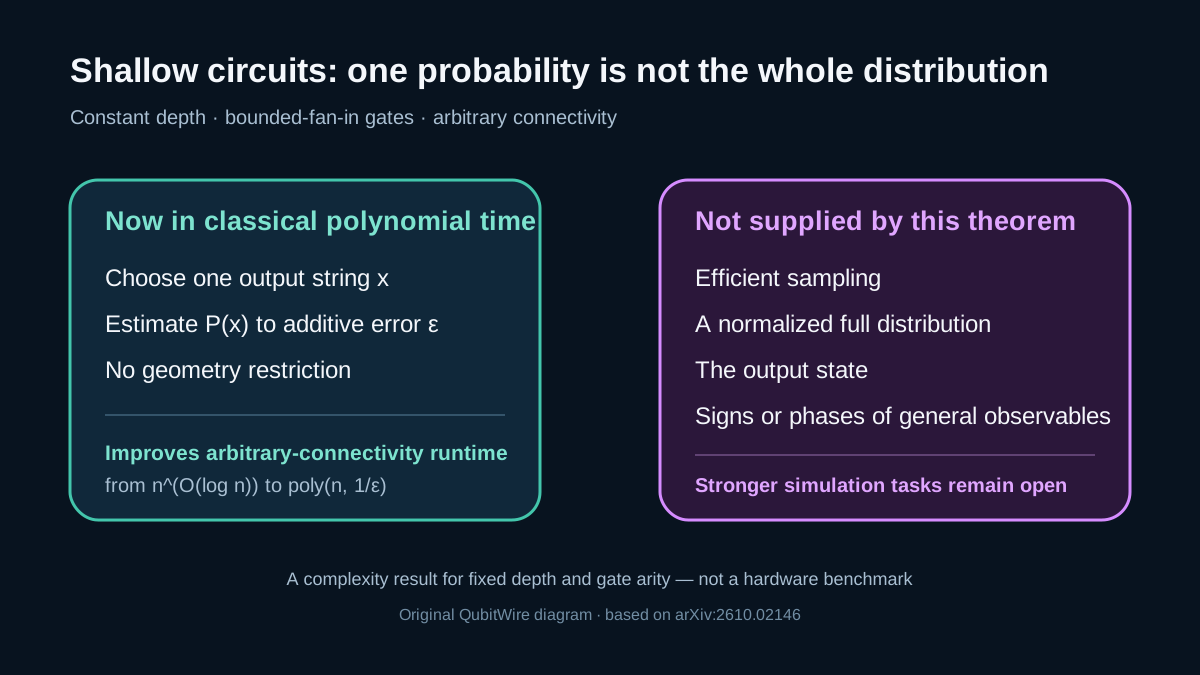
A deterministic classical algorithm can estimate any chosen output probability for fixed-depth, bounded-fan-in circuits in polynomial time, even with arbitrary connectivity. Sampling remains open.
Research3 min read
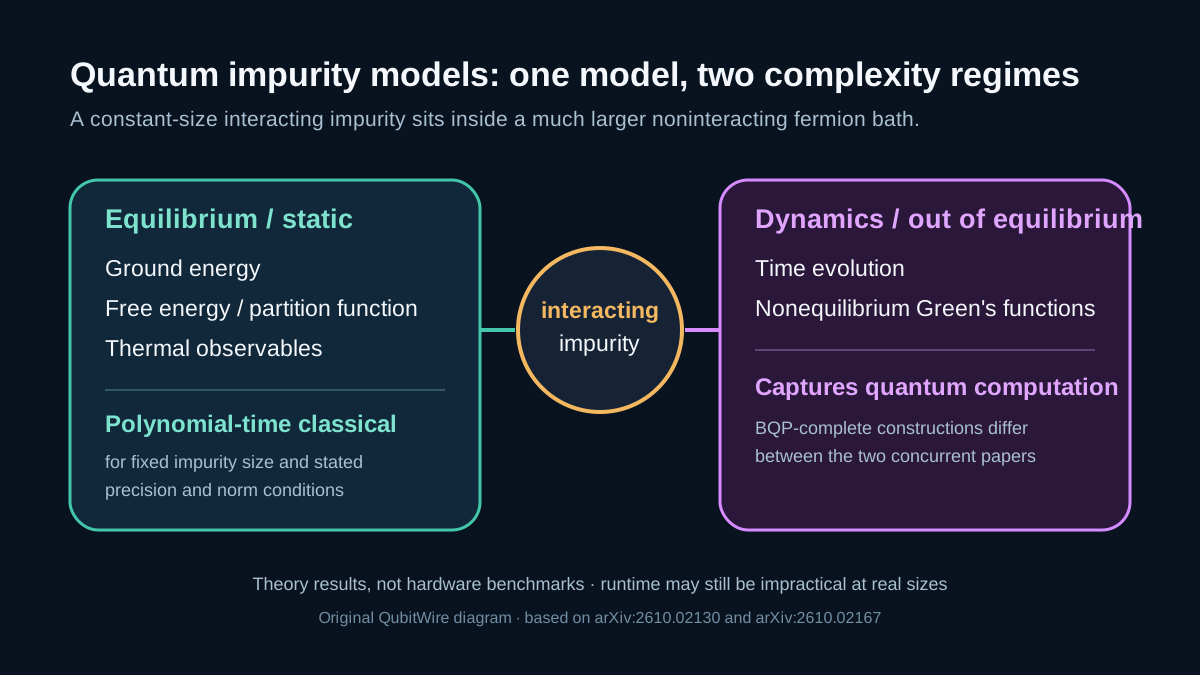
Concurrent proofs put static equilibrium properties in polynomial-time classical reach for a fixed-size impurity, while dynamics can still capture universal quantum computation.
Research3 min read
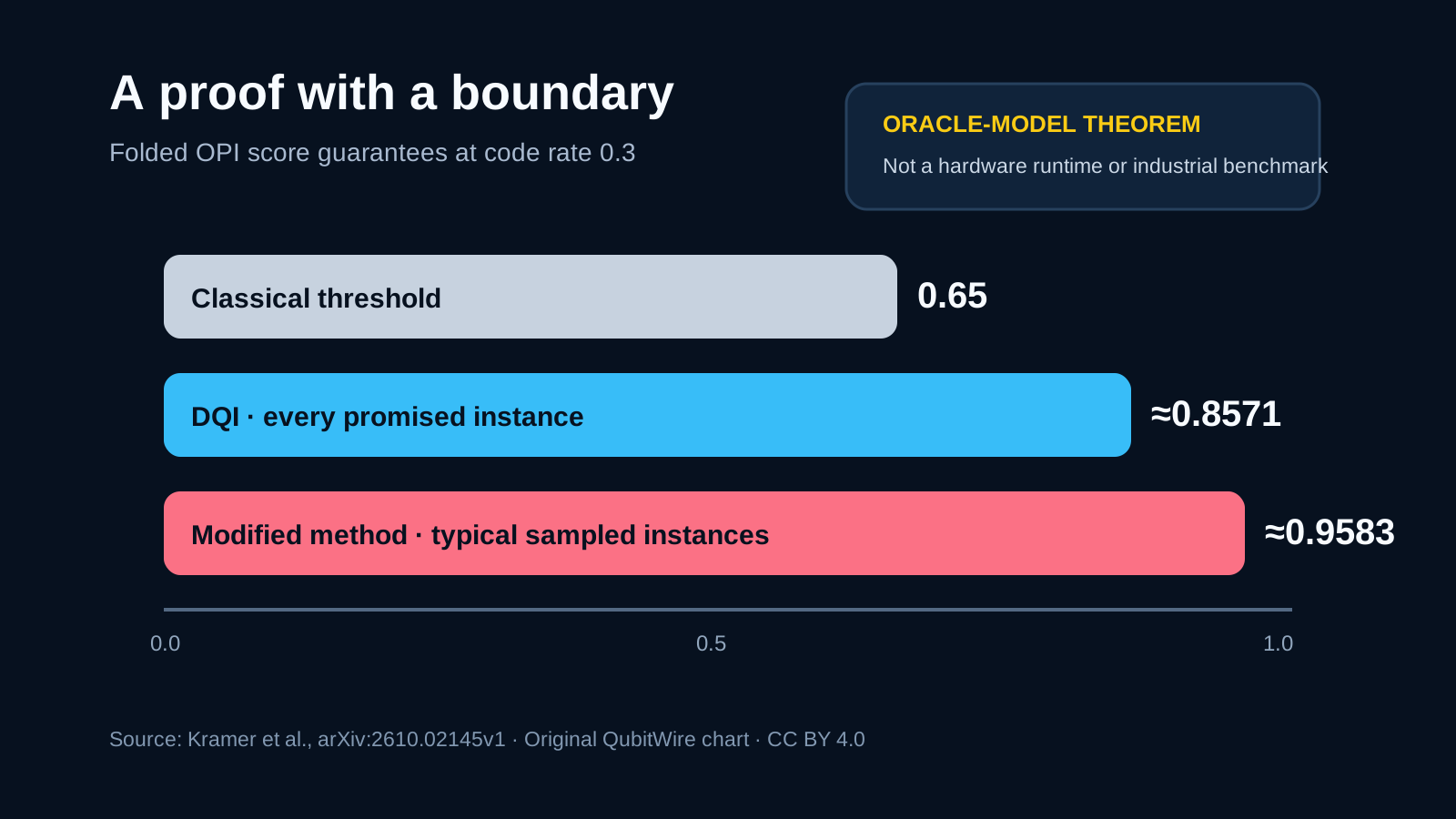
A new theorem separates a quantum method from every polynomial-time classical algorithm in its oracle setting. The oracle is the point, not fine print.
Research3 min read
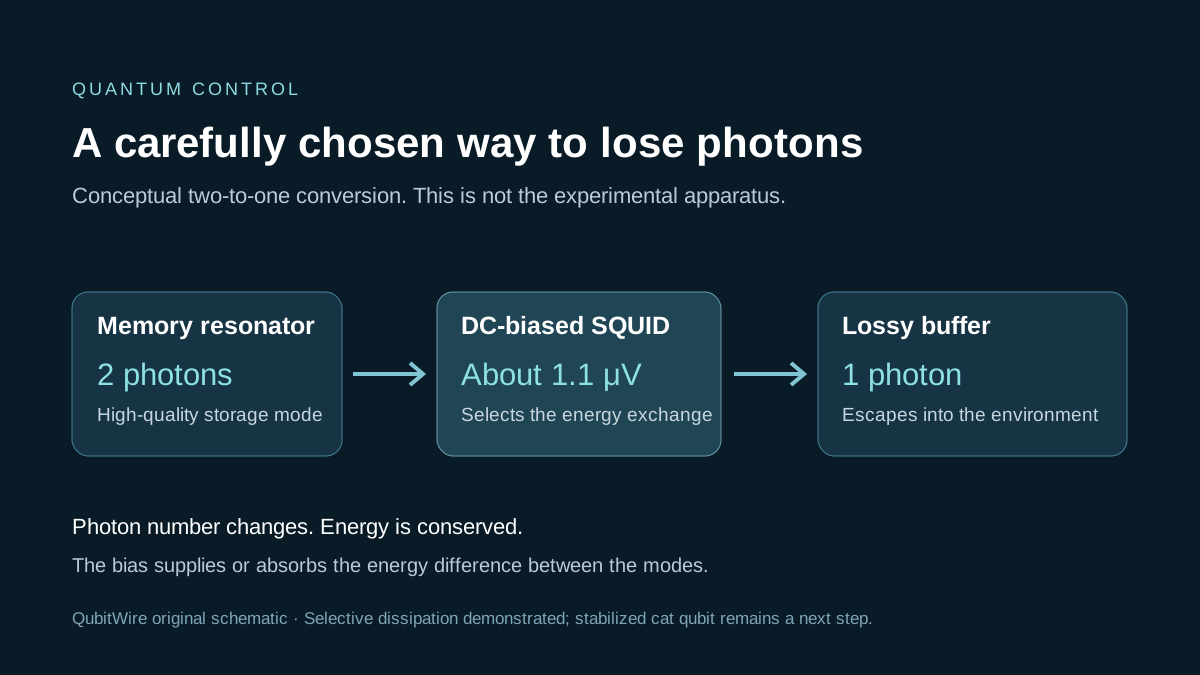
A new superconducting experiment turns selective photon loss into a useful ingredient for cat qubits. The protected qubit itself is still a next step.
Research3 min read
A Singapore comparison of lutetium-ion clocks makes small differences in height part of the measurement. The story is about gravity as well as time.
Research3 min read
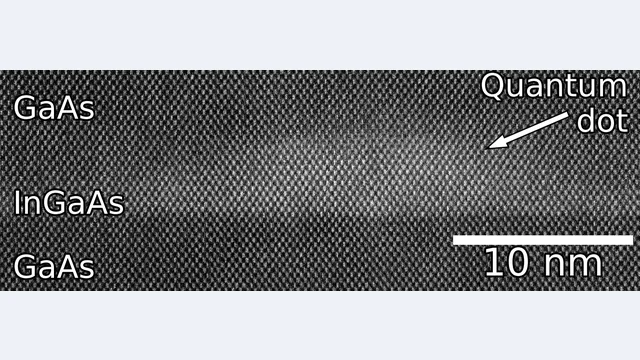
A gallium-arsenide experiment reveals how a crowd of electrons can carry charge in unexpected portions. It is not a photograph of an electron being cut up.