Research4 min read
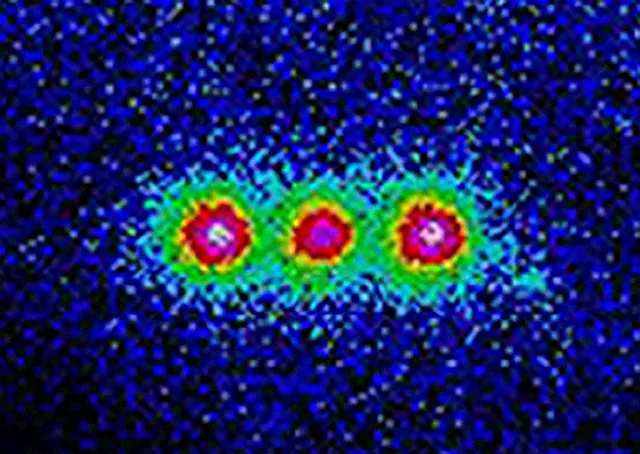
Researchers have observed bound atomic clusters known as Bethe strings in an ultracold, effectively one-dimensional gas. The name belongs to a many-body model, not to fundamental string theory.
Research4 min read
A theoretical study described as “Cosmic Lockdown” examines how decoherence can affect tunnelling in a model. It is not an observation that the real universe has stopped evolving.
Research4 min read
A new preprint describes a cheaper way to perform a particular quantum memory operation. The improvement is a resource count, not a stopwatch result, and the difference is the story.
Research4 min read
A newly funded Fermilab project will test whether four entangled probes can detect a weak signal more effectively than independent sensors. It is a plan for a controlled experiment, not a dark-matter discovery.
Research4 min read
A new Fermilab project will use magnetic vortices to investigate hidden sources of superconducting loss. It is a proposed way to diagnose a problem, not an announcement that the problem has been cured.
Research4 min read
A 2025 research study used a quantum processor to explore a simplified field-theory collision. The achievement is a controlled simulation, not the creation of high-energy particles in a computer.
Research4 min read
A recent homodyne study uses the structure of measurement noise to improve an estimate. It is a reminder that a clearer answer does not always require a different quantum state.
Research3 min read
An IBM experiment steers deliberately scrambling quantum circuits toward order. Resetting a system and keeping its information safe remain different achievements.
Research3 min read
A thorium nucleus now steers a laser through a feedback loop. The advance is a working nuclear time reference, with new questions to test.
Research5 min read
The same circuit picture can hide different experiments. A useful record follows the calculation from its original question to the result people can check.
Research6 min read
A 2022 JILA experiment measured relativity across a millimetre-scale cloud of atoms. It shows how better clocks can reveal differences in the world around them.
Research7 min read
Two qubits and two vibrations recreate a counterintuitive effect: possible paths can cancel. Oxford’s trapped-ion simulator makes quantum interference tangible.
Research4 min read
Three questions about the task, the answer and the clock can make quantum performance headlines far easier to understand.
Research4 min read
An October 5 theory and simulation preprint records when a control qubit decays. The striking modeled reduction in logical errors comes with a separate measurement-cost tradeoff.
Research4 min read
An October 6 preprint finds coherence in a complete three-time process even when pairwise tests miss it. An IBM hardware demonstration shows why a quantum diagnostic needs an explicit scope.
Research5 min read
A peer-reviewed numerical study combines joint measurements with Bayesian shot allocation. The method helps most when many Pauli terms conflict, but its extra qubits, sign ambiguity and untested hardware noise set a clear boundary.
Research6 min read
An October 5 preprint combines AI-guided search with mathematical verification to expand a quantum-circuit catalog. The designs are theoretical; complete hardware savings remain to be established.
Research6 min read
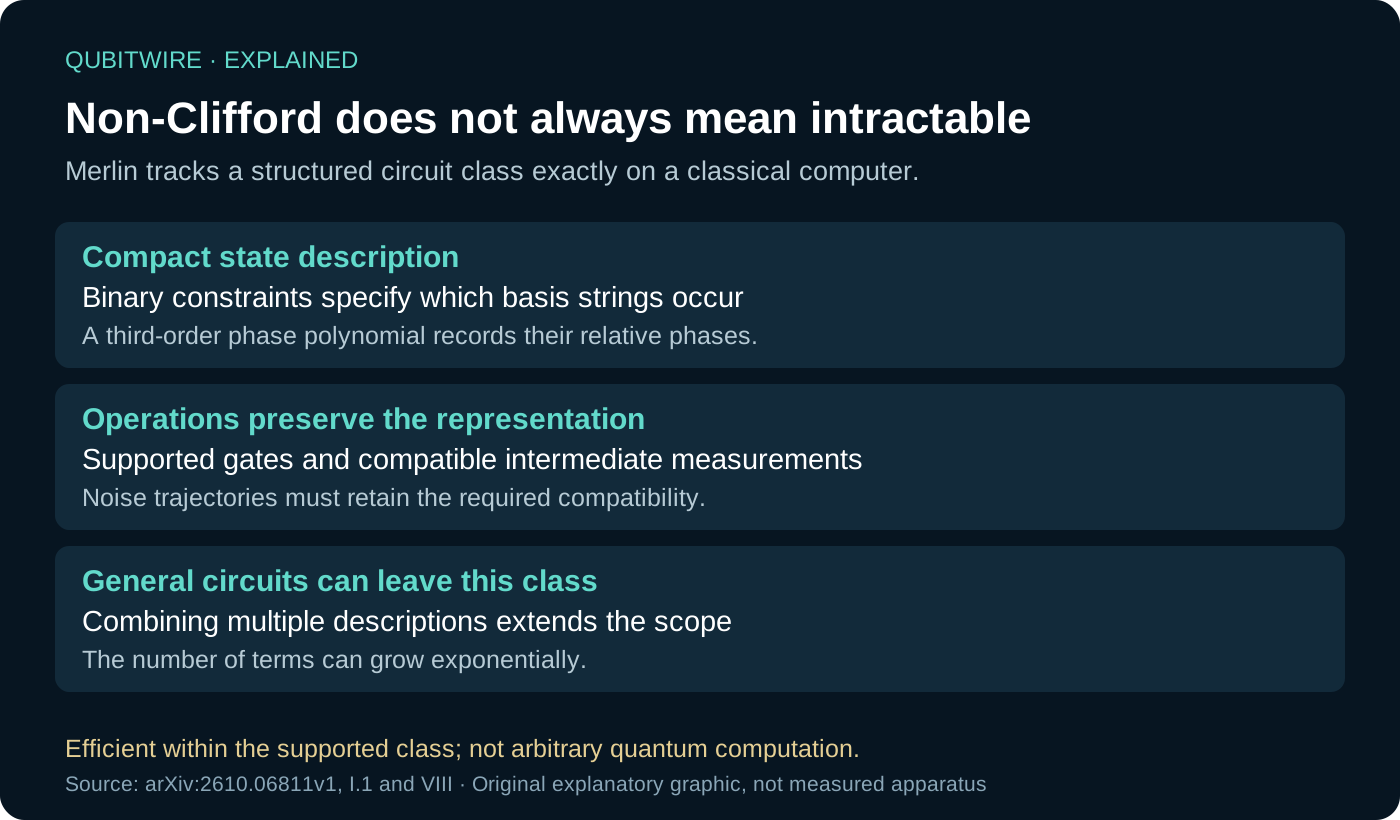
An October 5 preprint gives exact polynomial-time simulation for a restricted non-Clifford circuit class. Its benchmarks reveal why the best simulator depends on the workload and sampling budget.
Research6 min read
An October 5 preprint tests a hardware-screening method across ten quantum processors. Its strongest question is whether cheaper checks can identify where logical-memory experiments will work best.
Research6 min read
An October 6 preprint puts quantum-memory tests on a common footing. Its experiment shows why high conditional fidelity can coexist with low retrieval efficiency.
Research2 min read
An October 2 preprint reports modular neural decoding of IBM memory and lattice-surgery experiments. Reusing the architecture reduces redesign, but live processing speed remains unmeasured.
Research3 min read
qBitTensor says two independent solvers found the hidden outputs of its 48–56-qubit peaked circuits after a three-month stand. The implementations are not yet public, so the result is a red-team report—not an independently reproduced benchmark.
Research3 min read
Two theory papers draw a geometry boundary: depolarizing noise lets shallow circuits on a line break into classically simulable pieces, while a planar construction still separates from AC0 below a threshold.
Research2 min read
A simulation study replaces a destructive diagnostic with mid-circuit information and finds protocol-dependent overheads—from 10% to about 5×.