Research5 min read
The same circuit picture can hide different experiments. A useful record follows the calculation from its original question to the result people can check.
Hardware3 min read
A new Quobly–SiPearl agreement asks how a quantum processor should fit into a conventional computing system. The interface and the complete workflow are still work to be demonstrated.
Business + Policy3 min read
Universal Quantum’s more-than-US$100-million financing puts modular trapped-ion computing back in focus. The engineering test is what can cross between modules without losing its usefulness.
Research6 min read
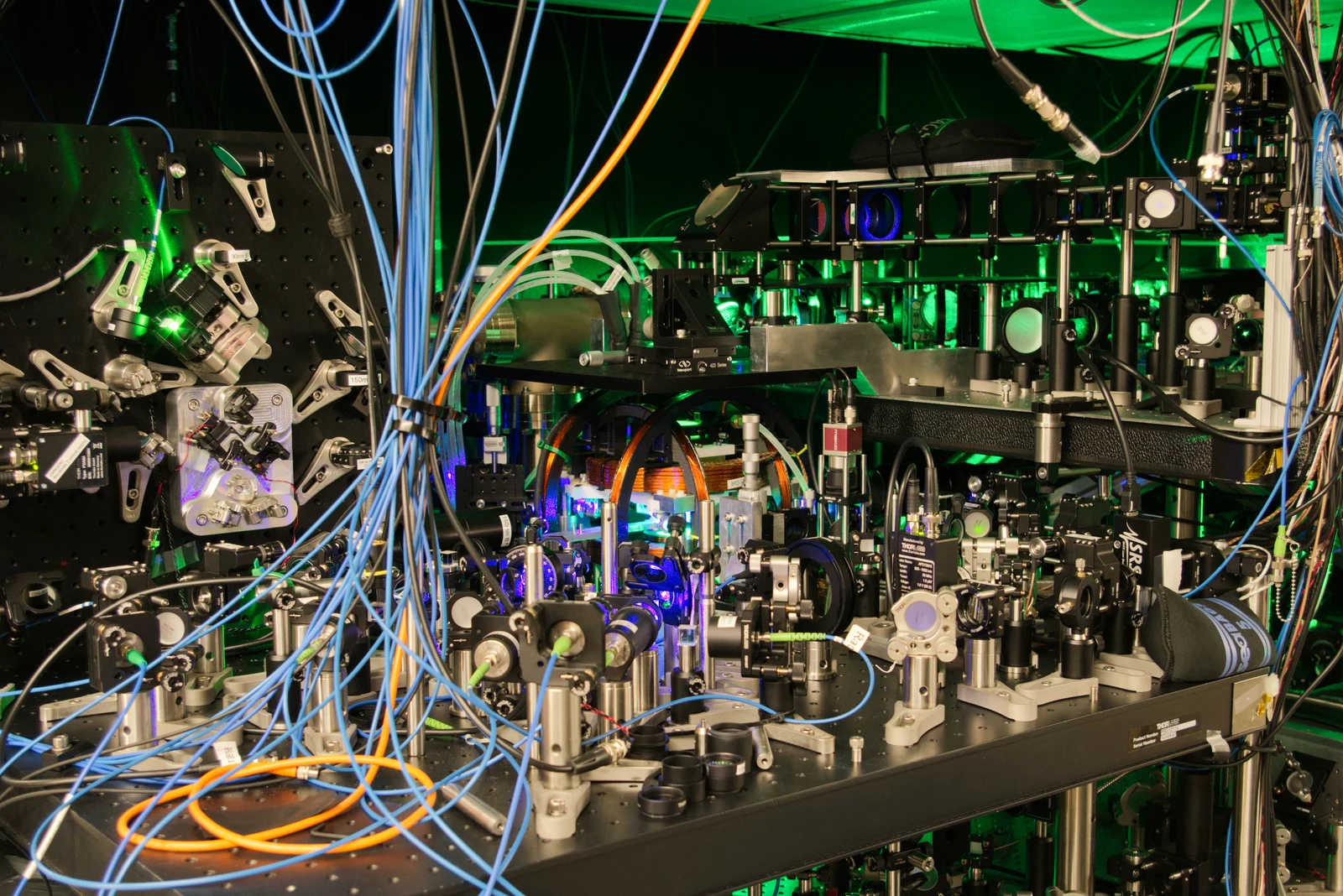
A 2022 JILA experiment measured relativity across a millimetre-scale cloud of atoms. It shows how better clocks can reveal differences in the world around them.
Applications6 min read
CURBy’s 2025 Bell-test service connects public random values to inspectable records. That can help a transparent draw, while its rules still determine whether the process is fair.
Business + Policy8 min read
DOE’s October 8 agenda names problems in chemistry, materials, subatomic physics and mathematics. It shifts the conversation from machine size to scientific value.
Research7 min read
Two qubits and two vibrations recreate a counterintuitive effect: possible paths can cancel. Oxford’s trapped-ion simulator makes quantum interference tangible.
Applications7 min read
Quandela and KRIBB will combine photonic quantum computing, AI and biology. The useful test is whether the work helps scientists choose what to test next.
Applications6 min read
Q-CTRL’s August trial used gravity measurements to check a ship’s position over an 83-kilometre route. Maps, conventional instruments and error bounds are part of the story.
Business + Policy4 min read
Four more teams have reached DARPA’s final evaluation stage. The test ahead asks whether a quantum computer can deliver more value than it costs.
Hardware4 min read
An expanded Infineon–ZuriQ partnership puts the factory question in focus: how does a promising quantum device become a machine that can be built again?
Applications4 min read
NTT DOCOMO BUSINESS and Classiq are partnering in Japan. Their announcement highlights the practical test for any quantum pilot: does a better answer change a real decision?
Business + Policy4 min read
NVIDIA’s five-year science commitment includes quantum computing. The broader story is the classical work required to design, compare and eventually operate useful quantum systems.
Business + Policy4 min read
Oratomic reports $775 million in cumulative financing. Its neutral-atom bet connects ambitious error-correction research to a machine that still needs to be demonstrated.
Research4 min read
Three questions about the task, the answer and the clock can make quantum performance headlines far easier to understand.
Research4 min read
An October 5 theory and simulation preprint records when a control qubit decays. The striking modeled reduction in logical errors comes with a separate measurement-cost tradeoff.
Research4 min read
An October 6 preprint finds coherence in a complete three-time process even when pairwise tests miss it. An IBM hardware demonstration shows why a quantum diagnostic needs an explicit scope.
Research5 min read
A peer-reviewed numerical study combines joint measurements with Bayesian shot allocation. The method helps most when many Pauli terms conflict, but its extra qubits, sign ambiguity and untested hardware noise set a clear boundary.
Hardware4 min read
An October 6 manufacturing agreement targets low-loss optical circuits and photon-counting detectors. The next evidence should show whether the transferred process delivers repeatable components that meet a quantum system’s requirements.
Research6 min read
An October 5 preprint combines AI-guided search with mathematical verification to expand a quantum-circuit catalog. The designs are theoretical; complete hardware savings remain to be established.
Research6 min read
An October 5 preprint gives exact polynomial-time simulation for a restricted non-Clifford circuit class. Its benchmarks reveal why the best simulator depends on the workload and sampling budget.
Hardware4 min read
An October 6 preprint automates superconducting-chip layouts. Current project documentation says the public release does not yet include the routing stage.
Hardware6 min read
An October 6 preprint demonstrates a fiber-connected telecom photon source. More pump power brings more pairs, but their quantum-state quality falls.
Research6 min read
An October 5 preprint tests a hardware-screening method across ten quantum processors. Its strongest question is whether cheaper checks can identify where logical-memory experiments will work best.