Research3 min read
A cold crystal preserved quantum correlations while information waited in a spin state. That is a useful component for a future network, with more work still to do.
Research2 min read
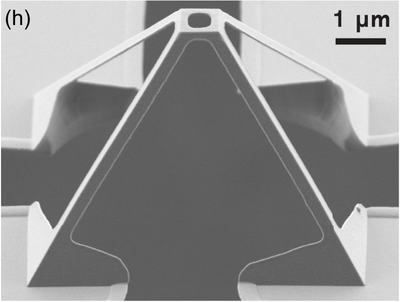
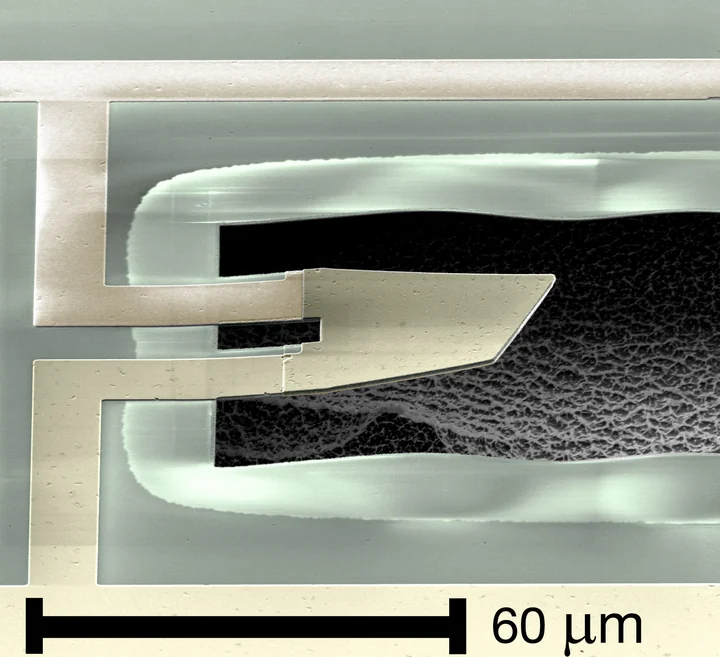
A wireframe SQUID on a cantilever tackles the geometry of measuring very small magnetic signals.
Research2 min read
Classical shadows help researchers estimate useful properties without reconstructing an entire quantum state.
Research2 min read
A new benchmarking framework asks how much useful circuit a machine can handle, and how quickly it can handle it.
Research2 min read
Michelle Y. Simmons, John Preskill and Krysta M. Svore offer three different ways to understand the work ahead.
Research2 min read
A silicon-carbide experiment moved fragile quantum information into nuclear-spin memory at room temperature. It is a storage result, not a room-temperature supercomputer.
Research2 min read
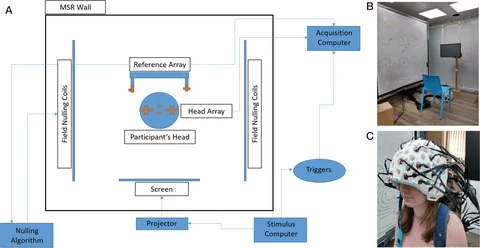
Stanford's magnetic brain-imaging system uses quantum-sensitive sensors close to the scalp. Better measurement is the aim; this is not a mind-reader.
Research2 min read
A simulator using 13 active trapped-ion qubits explored how an electric-field string breaks in a simplified particle-physics model. The behavior began near the edges.
Research2 min read
Researchers transferred an image through 100 separately addressable optical modes, testing how quantum state transfer can operate in parallel.
Research2 min read
A mathematical comparison reveals advantages for quantum circuits on specific tasks, with the language-model architectures and resource limits carefully defined.
Research2 min read
A microscopic resonator revealed the sudden loss of one phonon. Repeated measurements made the fleeting change visible.
Research2 min read
A room-temperature experiment takes a faster route to entanglement. The important number is four, not millions.
Research2 min read
An IBM preprint explores how to reduce the measurement burden behind cleaner answers. Its 63-fold figure needs a careful label.
Research2 min read
A newly published photonics result puts several essential functions together. That is different from fitting an entire quantum computer on a chip.
Research2 min read
The 13,000× benchmark estimate grabs attention. A result another quantum computer could check is the more useful idea.
Research5 min read
A new blueprint turns helium’s tiny mass into a computing resource. The surprising part is what the atoms would do—not what they would cool.
Research6 min read
Qubits can accumulate errors while they wait. A surface-code experiment shows why the pauses between operations deserve more attention.
Research6 min read
Experiments with light make the order of quantum operations a controllable resource. The gain is specific—and it is not time travel.
Research6 min read
Qudits use more than two quantum levels. They offer a different way to build and measure quantum information—not unlimited readable data.
Research2 min read
Clavina combines programmable optics with specialized modules so one research platform can tackle different quantum tasks.
Research2 min read
A new theoretical design tackles a basic problem: knowing when a useful pair of entangled photons is available.
Research2 min read
The striking number concerns the work of designing a future quantum computer—not a quantum machine suddenly running every task faster.
Research2 min read
A photonic experiment shows that the timing of a simple intervention can change when entanglement disappears.
Research2 min read
A trapped ion shared a quantum connection across a 2.8-kilometer fiber loop carrying Ethernet and 5G traffic. The preprint tackles a practical networking problem.